Does C-19 give you a reason to skip a year in your sustainability reporting?
It’s a fair question, given that most companies will be short of resources and looking to save a few pennies.
We have a solution that saves money and time. More important, it helps you maintain your sustainability reporting record and keeps you connected to those stakeholders who need and want your information. This is especially true for the environment, social and governance (ESG) investors who are enjoying a boost from the commercial ravages of C-19.
Beyond legal
As my colleague Francesca Ward has pointed out, an increasing number of countries have legal requirements for non-financial reporting. The law will not be altered by C-19 and companies should be aware of the minimum statutory demands.
Voluntary reporting has become an onerous task for those who think it wise to tick all the boxes, among them standards and guidelines from the Global Reporting Initiative (GRI), the Sustainable Accounting Standards Board (SASB), the CDP and the Task Force for Climate-related Financial Disclosures.
If one has the resources and the ambition to satisfy all stakeholders – including the burgeoning ESG sector – then there is nothing wrong with offering a gold-plated report. Indeed, it sets you apart as a good corporate citizen pursuing a transparent relationship with all those who have a legitimate interest in the 360º performance of your business.
Feeling the pinch
But if your resources are limited, then we argue that our highly-targeted approach − Smart Reporting™ − is a legitimate and, well, a smart way to ensure you keep connected with those organisations and individuals who influence your prosperity.
What is Smart Reporting?
Here’s an example, from the innovative speaker company Sonos.
For its first sustainability report, the company was determined to create something its employees and leadership would read. It had to be short and sharp. Most important, it needed to share progress accurately and transparently on the Sonos sustainability key performance indicators.
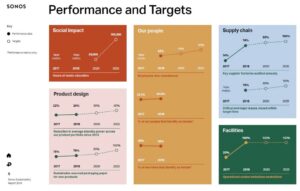
With less than 200 words a page, in a concise 30 pages, Sonos shares its sustainability progress and ambitions. The report’s showpiece is the one-page KPI dashboard which tracks its performance and goals. The format resonates with the company’s leadership and can easily be updated quarterly to share progress with employees and other stakeholders throughout the year.
Smart principles
Small, big or gigantic, the Smart Report™ principles apply to all companies:
Brevity − keep it short
Clarity − make sure it’s easily understood
Relevancy − ensure it concentrates on what matters to the audience
Transparency − it’s OK to push your core messages, but not to obscure the truth
Keep those principles in mind in your planning. Then take these four steps to success.
Smart Steps to Success:
Define the audience. Understanding the needs of your audience helps you decide on the extent of the content and how you want to present it. Plot the information needs of different stakeholders on a matrix. If you’ve done a materiality assessment in recent past, cross check with that and fill any obvious gaps.
Focus on what’s important to the audience. Collect the relevant and essential information. Feel free to ignore nice-to-haves and the gold plating.
Choose a format. Does your audience want a web report or a simple downloadable PDF? The Smart Report lends itself to both. Remember, investors and raters/rankers prefer a time-bound document.
Present the content clearly. Use good design, infographics and simple writing.
Job done for another year. Here’s hoping for a more prosperous 2021.
If you’re unsure about the future of your sustainability reporting during C-19, we’re here to help. Our Smart Report™ will keep you connected to your key stakeholders while saving time and resources compared with conventional reporting.
Reach out to our Smart Report™ expert Lisa for more information.
Gone are the days of optional CSR reporting. Indeed, they disappeared a couple of years ago for large companies in Europe – all thanks to the catchily-named EU Non-Financial Reporting Directive.
With this directive now under review, we look at sustainability reporting laws across the European Union to see where things stand for business.
The background
The European
Commission adopted the EU Non-Financial Reporting Directive 2014/95 – to use its full name – back in December 2014. Its roots stem from a realization around 2011 that greater attention needed to be paid to corporate sustainability risks and impacts. EU member states wrote the Directive into national law, with large listed companies (among others) expected to report first, in 2018.
Under the Directive, companies with over 500 employees must publish annual reports detailing risks and policies concerning: environmental protection, social responsibility and working conditions, respect for human rights, anti-corruption and bribery, and diversity on company boards. This non-financial reporting supplements financial figures, providing better insight into a company’s risks.
The Directive is principles-based and does not dictate the format of the reporting – only that companies should make the required information available or provide reasons why not.
What of the present?
As part of the Green Deal, the EU’s new growth strategy announced in 2019, the Commission states companies and financial institutions need to increase disclosure of climate and environmental data. Only with more data, it is argued, can investors properly understand the long-term health of their investments. This announcement kickstarted the review of the Directive. It’s now under public consultation until 14 May 2020.
So how have the different member states implemented the Directive? And have any introduced stricter reporting requirements that go beyond the Directive? We looked at ten EU member states to find out.
A note on methods
Specifically,
we researched Austria, Denmark, France, Germany, Ireland, Italy, Netherlands, Spain, Sweden and the United Kingdom – some of the EU’s largest economic hubs. We focused on statutory reporting provisions, requiring disclosure of environmental and social information to shareholders or directly to the public. Note, we excluded corporate governance reporting requirements.
What must business report?
All ten EU member states reviewed had, unsurprisingly, transposed the Directive into national law. But national variations abound. Governments have tailored policy applicability to suit national contexts, with Denmark and Sweden requiring companies with over 250 employees to report – half that required under the EU Directive.
Variations in the timings permitted for releasing information are also plentiful. For example, companies in Austria must disclose information at the same time as their management report, while companies in Ireland have six months to publish non-financial information. Other variations include where information must be available, how long it must be available for, and the level of guidance on what disclosures should cover.
Some member states have gone beyond the content of the Directive. In terms of mandatory public reporting requirements, France, the UK, and Germany are of note. The topics covered by further legislation break into three camps:
Gender pay gap reporting: France, the UK and Germany all require companies to report on metrics related to equalizing differences between genders in the workplace. Requirements vary. For example, following a phased introduction of the provision, French law necessitates companies with over 50 employees to report. Meanwhile UK regulations require reporting from companies with over 250 employees and German law requires status reports from those with over 500 employees. Reporting is required every 3-5 years in Germany, but it’s expected annually in France and the UK.
Human rights reporting: Companies must release statements disclosing human rights due diligence measures and their implementation. The UK Modern Slavery Act requires companies to publish an annual statement, available from their website’s homepage, while the French Duty of Vigilance Law obliges companies to report on implementation of due diligence procedures in their annual management report.
Greenhouse gas (GHG) reporting: Some member states have more detailed requirements concerning disclosure of GHG emissions. France, for instance, requires certain companies to publish a GHG inventory every 3-4 years, while in the UK companies of a certain size are expected to report carbon dioxide emissions in their annual director’s report.
Into the future
There’s broad consistency in the types of information EU member states (or former member states as in the UK’s case) seek companies to disclose, with the most regulatory detail currently focused on social issues including human rights and gender equality. It’s clear we’re likely to see stronger requirements – and that these requirements will probably focus in on broader issues such as climate change, all through the lens of making information more accessible to investors.
Companies
should examine the recommendations of the Task Force for Climate-related Financial Disclosures and be ready to link reporting on environmental and social risks more clearly to financial accounting. This might sound daunting, but leading businesses are already making the connections.
Now’s the time to future proof by ensuring a sound sustainability strategy, supported by information and data that complies with the law and underlines the authenticity of your commitments.
IKEA and H&M Group are striving to be climate positive. Microsoft is committed to be carbon negative. BP says it will help its customers become carbon neutral, while its corporate ambition is to become a net zero company.
Well, that’s all crystal clear then.
When carbon counting meets public relations, it’s inevitable that confusion follows. By trying to keep a sunny view of a gloomy situation, the word mongers in the climate change debate have produced a range of terms that don’t make a lot of sense without a lot of explanation.
As BP says in the notes to its net zero announcement: “Such terminology and related methodologies may evolve over time…”
Understanding evolving terms
A cursory knowledge of double-entry booking is handy because it helps you understanding the frequent and important use of the word “net”, as in net profit when there is nothing else to be taken away (such as taxes).
Because the carbon cycle involves carbon being emitted (e.g. airplane exhaust fumes) and simultaneously removed from the atmosphere by natural processes (e.g. growing trees), carbon accountants are interested in the carbon left over, the net carbon. It’s that carbon which contributes to climate change.
Here’s a quick guide to the four terms currently used by business to describe their climate ambitions.
Net Zero. This refers to greenhouse gas (GHG) emissions. It means your total GHG emissions amount to zero after you have deducted those emissions that are stored in natural sinks (plants, soil, sea) or removed in other ways, such as carbon capture. Methods of measuring the deductions are evolving too, and it’s inevitable that this will encourage some creative accounting when approaching the distant deadlines to achieve net zero.
Carbon Neutral. The old-fashioned way of saying Net Zero. The term went out of favour because companies achieved neutrality mainly through offsetting, which is frowned upon by the cognoscenti because of dubious practices associated with it. Some offsetting activities, such as paying to conserve existing forests, are considered negative because you’re paying not to do something, such as cutting down a forest.
Climate Positive. By going beyond net zero you can claim to be climate positive. This means you will be removing moreGHG emissions than all the GHG you emit. This makes little sense until the concept is explained. Once you get to net zero emissions (energy efficiency, using renewables etc) you must help others, such as suppliers and customers, reduce their emissions that also contribute to your carbon footprint. Achieving climate positive status is really, really difficult. But it is seen to be very good thing because it removes additional carbon from the atmosphere, creating a positive outcome for the environment.
Carbon Negative. This means the same as climate positive. Companies who prefer this term, such as Microsoft, would argue that it is scientifically more precise because success takes you below zero and into the negative. Users of climate positive say why use a frowny face (negative) when you can emote with a smiley?
Despite the confusing and “evolving” terminology, the good news is that many companies are taking climate change extremely seriously and have developed robust plans to do something about it. Of course, this all happened before the coronavirus meltdown. But we trust and hope that once we emerge from the dark days of lockdown, the good work on combatting climate change will continue.
Till then, it’s worth looking at BP’s argument and commitments to be a net zero company by 2030. The oil major has gone much further than its competitors. Essential reading is Microsoft’s well-written blog on its plans to be carbon negative by 2030, and by 2050 to have removed all the carbon it has emitted since its founding in 1975.
Today, Sonos published their Fiscal Year 2018 Sustainability Report.
It has everything you would expect a tech company to cover, from product design to inclusion and diversity to supply chain responsibility. But what makes this report different? It’s only 25 pages.
Sonos wanted to create a report that people would actually read. But it also needed to be accurate and transparent.
The solution? A Smart Report. It has everything you need, and nothing you don’t.
Below are key features of the report that not only make the shorter format effective but make it an overall interesting read.
Material issues
Sonos only included topics that are both important to their business and to their stakeholders. Staying true to these material issues kept peripheral content out of the report.
KPI dashboard
A key aspect of the report is the one-page key performance indicator dashboard which tracks their performance and goals. This approach communicates a lot of information in a digestible format. It’s easily updated throughout the year so they can share quarterly progress in between sustainability reports.
Strategic content
Each subsection is organized the same way: Approach, Performance, Goals (if applicable), and Future Plans. Keeping the content consistent across sections provides a concise but comprehensive description of each material topic.
Case studies
The stories are short but help to humanize their program, adding depth to the ‘Approach, Performance, Goals, Future Plans’ structure described above.
Your sustainability program is firing on all cylinders. You’ve got goals, you’re making progress, and you’re adding value to your business. After publishing your sustainability report, you think you’ll finally get credit for your efforts.
But will you?
According to the Reuters Institute (PDF), in 2018, social media was the leading source of online news stories for people ages 18 to 34, even exceeding internet searches. So, for many in this age group, the only way you can catch their attention is on social media. They will not be visiting your website anytime soon, let alone downloading your perfectly formed sustainability or corporate social responsibility report.
Social media may not seem like a good fit for sustainability messages. Posts are usually short and visually engaging. In contrast, sustainability content is often nuanced, and fun images and videos hard to come by. Six of the top 10 companies represent the technology sector.
So, how can sustainability teams make an impact on social platforms? Context America’s first “Susty Social Media Ranking” set out to answer many questions that are top of mind for our clients and sustainability professionals generally:
“Which platforms are most popular?”
“Do we need a dedicated sustainability handle?”
“How frequently should we post?”
“What’s the best way to engage sustainability influencers?”
“How much engagement can we generate?”
“Which companies are using it most successfully?”
The methodology and success metrics
We observed that most companies in the ranking are using a blend of social media platforms. Facebook, LinkedIn and Instagram are all quite frequently used. But we found that Twitter is the most commonly used platform for corporate sustainability teams.
With that in mind, we based the ranking on data related to Twitter postings, specifically during June. This simplified the analysis and enabled direct comparison between the 100 companies we selected for ranking. We plan to publish a second ranking focused on Instagram and Facebook in the spring.
We used a broad definition of sustainability in the analysis — from information about volunteering activities to comments and commitments related to climate change. We defined three success metrics for the evaluation:
The frequency of sustainability-related posts — regular posting is a key factor in building an audience Number of influencer followers — an indication that posts are credible and relevant Amount of engagement generated (likes, retweets and replies) — more engagement is the overall objective
Does your team need a dedicated sustainability handle?
We found that sustainability professionals generally use three kinds of Twitter handles to communicate:
Main corporate handle — 91 companies use this
Dedicated sustainability handle — 33 companies use this
Personal handle of sustainability leader — 52 companies use this
Data from all three handles — where available — was included in the ranking.
There are advantages to each type of handle. Posting sustainability content on a main corporate handle demonstrates mainstreaming of sustainability within the company. Usually, the corporate handle also has the most followers, meaning a broad audience will see your sustainability posts.
However, we found that sustainability influencers are more inclined to follow dedicated sustainability handles, and even more so personal sustainability leader handles.
How frequently should your team post?
Posting frequency was highest on dedicated sustainability handles, with an average of 29 posts per month. Corporate handles averaged 19 sustainability posts per month, with sustainability leader handles looking neglected at an average of five posts per month.
That said, the most active leaders are very active.
Mike Barry, director of Plan A and sustainable business at United Kingdom retailer Marks & Spencer, is the most active poster, averaging more than two a day. Chris Wellise, chief sustainability officer at Hewlett Packard Enterprise, is second, and Lynelle Cameron, vice president of sustainability at Autodesk, is third.
How do you earn influencer followers?
While it’s a standard social media goal to build a following, in the sustainability field, the quality of an organization’s followers is perhaps even more important than the total number.
“Influencers” have large followings of their own based on their sustainability posts. They are valuable because of their ability to spread your organization’s messages by re-posting your content.
We found that influencers prefer to follow personal sustainability leaders over company handles, demonstrating the power of personal relationships over anonymous corporate profiles. The top seven personal sustainability leader handles actually have more influencer followers than their companies’ corporate handles.
How much engagement can your team generate?
Microsoft easily tops the engagement table with a whopping 18,000 sustainability likes, comments and retweets on its corporate Twitter handle.
The top dedicated handle is The Home Depot with nearly 3,000, and the top personal handle is Lisa P. Jackson, vice president of Environment, Policy and Social Initiatives for Apple, with nearly 800. See the table below for the top 10 engagement numbers in each category.
The top handles, ranked by engagement.
Overall best performers
Combining the rankings for frequency, influencer following and engagement, produced our overall Top 10 ranking for performance, headed by Cisco. (See the lead chart in this article.)
Seven of the top 10 are business-to-business companies. Six are from the technology sector. Three business-to-consumer brands also made the Top 10: Johnson & Johnson (third), Nestlé (eighth) and Marks & Spencer (tied for ninth).