
The EU Pay Transparency Directive
What You Need To Start Reporting In 2027
The EU Pay Transparency Directive (EU PTD) is designed to accelerate progress toward pay parity. It requires employers to provide detailed pay metrics, share clearer information about pay and progression, and strengthen rights for employees and job applicants. EU countries had to transpose the Directive into domestic legislation by 7 June 2026. With that milestone now behind us, the focus shifts to delivery, and the countdown to the first reporting deadline has begun.
However, this isn’t the kind of information you can pull together at the last minute. Achieving compliance with the EU Pay Transparency Directive requirements relies on getting the foundations right, from accurate data and internal clarity on job structures to strong governance, documentation and a long-term plan for what to do if data gaps emerge.
Background To The EU PTD
Slow progress, mixed rules and uneven rollout
The EU PTD entered into force in June 2023, against a backdrop of uneven pay transparency rules across Europe. Some countries focused on reporting, others on audits. There was agreement on the principles of equal pay, but limited expectation to act on gaps. At the same time, progress towards pay parity has been slow.
Across the EU:
- The average unadjusted gender pay gap was 11.1% in 2024, narrowing by only 2.8 percentage points between 2012–2022.[i]
- The gender pay gap varies widely by country. In 2024, Estonia had the largest gap (women earned 18.8% less than men). Luxembourg had the smallest gap (-0.8%) and was the only EU country where average pay for women was higher than for men.
- The gender pay gap is highest in the finance and insurance sectors, and lowest in water supply, waste management and construction (14 countries recorded higher average pay for women in these sectors).
- In most countries, the gap also widens with age. For example, in France, women under 25 earn, on average, 5.2% more than men for work of equal value, but those aged 55-64 take home 21.5% less. This may be linked to older women having greater caring responsibilities, or to historically limited childcare or hybrid working provisions.[ii]
The EU Pay Transparency Directive is intended to raise the bar with clearer reporting requirements and stronger expectations for remediation.
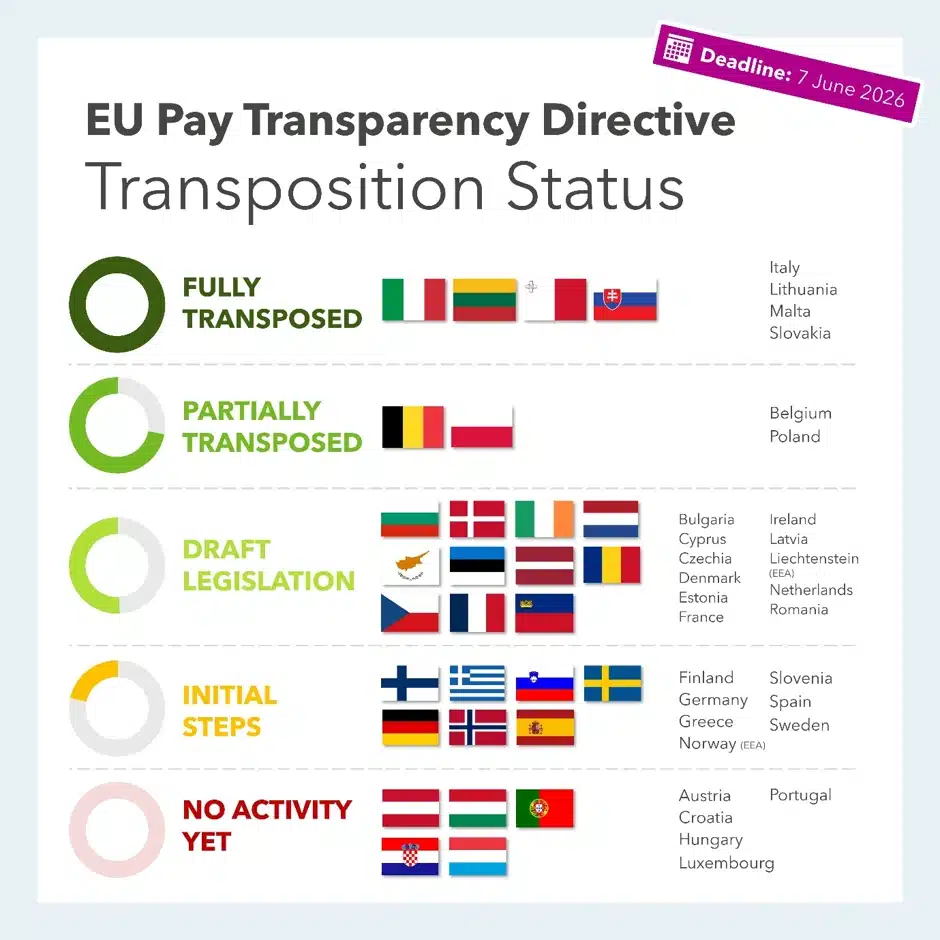
But implementation is currently uneven, with only three of 27 EU countries transposing the Directive into national law by the 7 June 2026 deadline. This brings uncertainty for multinational companies, as countries have some flexibility in implementation, for example, requiring action to address gaps as small as 2%, compared with the 5% threshold set by the Directive.
[i] Gender pay gap statistics – Statistics Explained – Eurostat
[ii] The gender pay gap situation in the EU – European Commission
EU PTD Unpacked: Reporting, Rights and Remediation
The EU PTD is designed to put the principle of equal pay into practice by linking reporting to remediation. That means employers must act to close pay gaps. In other words, it’s not only about what you report; the EU PTD also changes how pay decisions are made, explained, and discussed within organisations.
The fundamentals of the EU PTD
Core Provisions
The Directive:
- Defines “work of equal value” and makes it central to how pay comparisons should be made and reported, listing factors such as skills, effort, responsibility and working conditions.
- Gives employees and job applicants clearer information on pay and stronger rights to challenge perceived inequity. All organisations, irrespective of their size, must:
- Provide details on salary ranges during the hiring process.
- Refrain from asking about a candidate’s salary history.
- Not prevent employees from sharing salary information.
- Requires organisations to share information on pay when asked, including details of pay levels, the criteria used to set pay, average pay for comparable roles and a breakdown of pay by gender.
- Shifts the burden of proof, with employers expected to show that pay decisions are not discriminatory when disputes arise.
- Links reporting to action, requiring organisations to identify, explain and address unjustified pay gaps, not just disclose them.
Scope
The EU PTD applies to all public and private-sector employers in the EU and to any company with employees in EU member states, regardless of its headquarters location.
Company size (employees) |
Reporting frequency |
First reporting deadline |
| 250+ | Annually | 7 June 2027 (on FY26) |
| 150 to 249 | Every 3 years | 7 June 2027 (on FY26) |
| 100 to 149 | Every 3 years | 7 June 2031 (on FY30) |
| <100 | No mandatory reporting unless EU member states choose to change this during implementation. | N/A |
The Process
You’re in scope, so what’s next? Here’s our step-by-step guide to EU PTD compliance, starting with creating your internal tracking and gender pay gap report.
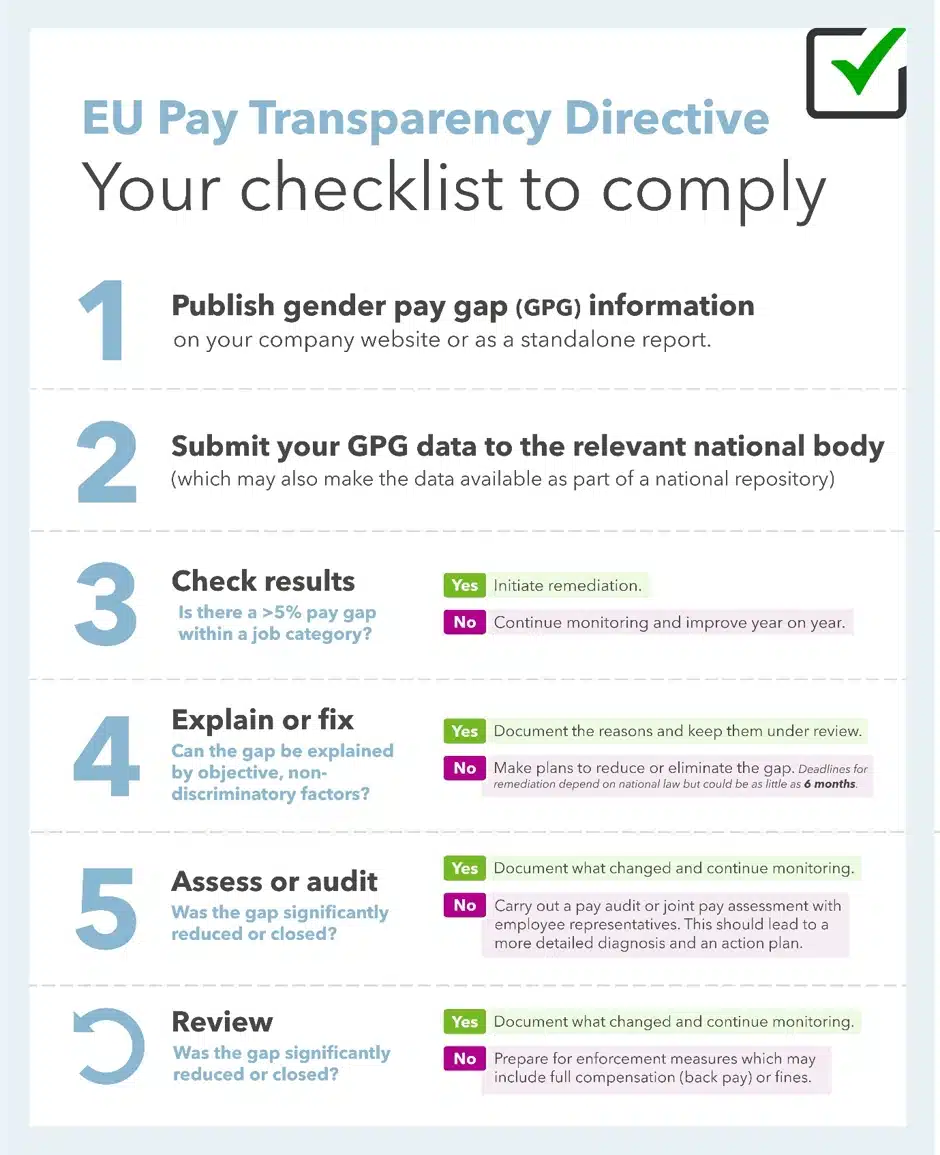
Getting Started: How To Prepare Now
The EU PTD isn’t a quick compliance exercise. Like many reporting requirements, it demands robust methodologies, clear governance, and a practical plan for explaining results and addressing pay gaps. For example, while it provides a definition of work of equal value, the Directive is not prescriptive on how organisations should measure it. This gives flexibility, but also means employers need to consider their choices carefully and be able to explain their approach.
Preparation is key and having a structured plan helps. Below are our top tips to help you shape the plan and get started.
- Start with a trial run. Test your approach to spot and fix gaps before they become public and to avoid penalties. If you’ve reported before, review your last gender pay gap report and the process you used to produce it. If this is your first time, produce a draft report including baseline data and commentary.
- Check your data. Look for anomalies and check that the calculations align with requirements. Key considerations include:
- Are job titles and levels consistent across the organisation or do you have different labels for the same role that need tidying up?
- Can you produce all the metrics the EU PTD will require?
- Is your HR / payroll system robust enough to reliably support EU PTD reporting?
- Prepare your narrative. Use the dry run to start writing your supporting statement. As you do, ask yourself:
- Can you explain the main drivers of any gender pay gaps clearly?
- If you give reasons for the gaps, do you have evidence to support them?
- Are you clear on what you will do next to improve?
- Reduce the gap. Use your draft report to inform your pay parity strategy. Based on the outcome of your trial run, actions could include:
- Making pay, progression and bonus decisions more consistent. Set out and use objective criteria for pay progression and promotion.
- Removing structural barriers that cause gaps to widen over time. Strengthen guidance on hybrid working (including in senior roles), paid parental leave and childcare support to ensure flexible arrangements are applied consistently.
- Giving employees sufficient ways to raise concerns. Use surveys and other mechanisms to flag issues.
- Improving internal communications on pay. Explain how pay is set, how decisions are made and what changes are underway.
- Supporting managers to explain pay decisions. Provide practical training and guidance on inclusive hiring, fair pay decisions and avoiding bias in performance and promotion.
Beyond Compliance: Resources, Retention and Reputation
While the Directive may feel like just another regulation to worry about, it can be much more than a compliance exercise. The lead-in time is a chance to put the right foundations in place and, done properly, that work can also deliver a range of benefits for your organisation.
Achieving compliance and strengthening your gender pay gap reporting processes can help you:
- Maintain your reputation and credibility. The EU Pay Transparency Directive increases the visibility of pay gaps. Unequal pay can drive negative media coverage and employee criticism, while organisations that proactively champion pay equity are more likely to build trust. Providing clear, credible explanations and evidence of action will protect your brand.
- Boost employee experience and retain a talented workforce. Clearer information on job levels, progression pathways and pay decisions helps employees see a future at the organisation, reducing employee turnover. It also makes it easier to attract top talent.
- Advance diversity, equity and inclusion goals. Acting on pay parity can also support stronger gender representation across the organisation over time, including at senior and board levels — a critical step in increasing workforce diversity.
- Improve resource management. Getting EU PTD-ready often means putting a clearer pay structure in place (job levels, pay ranges and consistent rules). That gives you the chance to sense-check whether pay across the organisation is fair, reflects the work being done, and helps avoid overspending due to inconsistent or ad hoc pay decisions.
- Get audit-ready evidence. A clearer pay structure and documented pay methodology make it easier to explain at audit, as your numbers are consistent, traceable, and make sense when scrutinised.
- Avoid penalties and remediation costs. Staying on top of requirements reduces the risk of fines, enforcement action, compensation and costly last-minute fixes.
- Exceed baseline expectations in sustainability reporting. The work you do towards EU PTD generates data and evidence that can help you report with greater confidence under the EU Corporate Sustainability Reporting Directive, the GRI, and other frameworks.
A Little More ABout Context
Context is a specialist sustainability consultancy delivering strategy, reporting and communications to businesses worldwide. For decades, we have helped companies across every sector navigate the complexities of sustainability reporting and produce reports they’re proud of. Today, our teams and custom tools help companies stay up to speed and connect the dots across requirements as expectations evolve.
If EU PTD reporting is on your horizon, Context can help you get organised early — whether that’s sense-checking your approach with a trial report, helping you shape a clear plan of action or keeping your narrative aligned and consistent with your wider reporting (including CSRD, GRI and ISSB-aligned disclosures).
