Businesses have long recognised that they can and should make a meaningful contribution to the UN Sustainable Development Goals (SDGs). And there’s a big prize on offer for solving major economic, environmental and social challenges and delivering on the goals — an estimated $12 trillion in business opportunities.
But in a growing number of cases, alignment is superficial, leading to accusations of SDG-washing — using the SDGs as a way to imply greater social and environmental impact. For example, the company mentions that it is partnering to deliver the SDGs (goal 17) because it has joined an industry body aimed at tackling deforestation, inequality, or another recognised sustainability challenge. Yet, it has not made any changes to its current sustainability strategy or ways of working.
Here are Context’s top tips for using the SDGs to drive meaningful change within your business.
1. Create a detailed map to guide your journey
For each of the 17 high-level goals, there are up to 12 targets — 169 targets in total. And for each target, there are between two and four indicators of progress. But many companies don’t look beyond the headline goals.
A comprehensive approach to SDG mapping requires companies to assess both their positive and negative impacts at the target level. It enables you to understand where the organisation can have the biggest impact, but also identify the trade-offs — where pursuing benefits in one area could cause harm in another. Building a new coal-fired power station improves access to affordable energy (goal 7), but also generates increased emissions slowing climate action (goal 13). A thorough evaluation also ensures no opportunities or risks are overlooked.
You will need to look at many of the same sources you use to identify and assess your company’s sustainability matters as part of any Double Materiality Assessment. Combining the two provides a rounded view of the company’s impacts, risks and opportunities.
2. Explore the full value chain
SDG mapping should cover the full value chain — not just the company’s own operations. A pharmaceutical company’s core focus on improving health and wellbeing (goal 3) may be undermined if new treatments can’t get to market. Looking upstream and downstream helps to identify the areas where partnership is essential for delivering on the aims of the SDGs (goal 17).
3. Adopt a less is more approach
With the exception of some multinational, portfolio businesses, few organisations can have an impact on all 17 SDGs. It is better to focus on just a few core goals without becoming blinkered to the company’s impacts — positive and negative — on other SDGs.
If impact is genuinely broader than just a few goals, you could reference linked goals where company actions create co-benefits. For example, providing better nutrition (goal 2) may help children to concentrate better in schools and enjoy the benefits of quality education (goal 4).
Transparency breeds trust. Stakeholders expect a company to explain its approach to prioritising the SDGs. That means showing the company has selected the areas where it can make the biggest impact and directly contribute to the target. A record of providing employee training does not represent a contribution to quality education (goal 4), though improving access in emerging markets to the textbooks the company produces might.
It also means acknowledging that the company can’t have a positive impact in all areas — and indeed in furthering one goal may generate trade-offs in another area.
4. Mind the gap
Companies should focus on the SDGs where they can have the greatest impact. But less scrupulous organisations have adopted the same approach with dubious motives.
Consider the soft drinks company that focuses on sustainable consumption and production (goal 12), but fails to address (or even acknowledge) its impact on good health and wellbeing (goal 3). Or how about the fossil fuel company that focuses on decent work and economic growth (goal 8), but overlooks climate action (goal 13).
These are deliberate instances of SDG-washing. But companies can face similar accusations when they fail to explain why they have chosen to put the focus on some areas and not others.
5. Integrate the SDGs into the core business
Some companies pepper their annual sustainability report with logos of the individual SDGs, but then the goals are not mentioned again until the following report. True impact only stems from integrating the goals and targets within the business.
Researchers at Stanford University have identified companies that have embedded the SDGs into everything they do. African technology company Safaricom has woven the goals into its statement of purpose, descriptions of team tasks and even personal objectives. This helps to explain how the finance team provides ‘transparency and visibility on our procurement practices and fighting corruption in all its forms (goal 16)’ or HR promotes decent work and good labour practices (goal 8).
Meanwhile, Danish biotechnology company Novozyme uses the SDGs as a lens to decide which new products to advance and which to shelve.
6. Measure and demonstrate progress
Impact is hard to measure, particularly in relation to systemic issues. Over 80% of business leaders have indicated that measurement challenges prevent progress towards the goals.
This is where comprehensive SDG mapping comes into its own. The Stanford researchers highlighted how Ramboll assessed revenues against its priority SDGs to identify which business units directly contributed to delivery of the goals and which didn’t. By shifting focus on to the business units with greatest impact, it was able to demonstrate progress towards the goals, while reducing negative impacts elsewhere.
7. Approach the SDGs as you would other reporting frameworks
Most companies mention their contribution to the SDGs in their annual sustainability reports, but rarely treat disclosures with the same level of thoroughness as other reporting frameworks such as the Global Reporting Initiative (GRI) or the IFRS’s International Sustainability Standards.
Greater visibility is needed. If a company says it is contributing to the SDGs, its commitment and actions should be clearly connected to the SDGs targets — and supported by robust data. The GRI’s business reporting database provides guidance on how the SDGs align with common reporting frameworks, enabling the SDGs to be integrated into wider reporting activities. Done well, it reassures stakeholders that companies are serious about their social and environmental impact and build trusts.
Referencing the company’s contribution to the SDGs in the CEO’s introduction to the annual sustainability report demonstrates that the commitment comes from the top of the organisation.
Context supports companies to map their impacts and understand their contribution to the SDGs and their material issues. This provides the foundation for robust sustainability strategy, reporting and communications – beyond the addition of a few SDG logos to your report. If you would like to talk about your organisation’s needs, please get in touch via www.contextsustainability.com or helen.fisher@contexteurope.com.
Sustainability reporting has moved from a useful exercise to an essential requirement for most organisations. Customers, regulators, investors, and communities want clear information about how businesses manage environmental risks, social responsibilities, and governance standards. These expectations increase each year, often faster than internal systems can adapt.
Many organisations still rely on reporting methods that were designed for a very different time. They depend on spreadsheets, manual calculations, and scattered data sources. These approaches make reporting slower, less reliable, and harder for teams to manage. The reference material you provided shows how ESG reporting now covers a wide range of topics, including emissions, social impact, and governance structures. This variety makes modern reporting more complex and harder to complete with outdated systems.
A smarter approach is now essential. Smart sustainability reporting allows organisations to collect, organise, and communicate information in a more structured and efficient way. This article explains how that shift works and offers practical steps for organisations that want to improve their reporting approach.
Why sustainability reporting feels harder than it should
Many organisations struggle with sustainability reporting even when they have strong intentions. Several patterns explain why the process has become so demanding.
Data comes from many places. Information sits across finance teams, operations, HR, procurement, and external partners. Gathering it manually creates delays and inconsistencies.
Frameworks keep evolving. Companies must understand different regulations, ranging from climate disclosures to modern slavery requirements. As the provided material notes, regional rules across the EU, UK, and USA add pressure for consistent data and internal controls.
Stakeholder expectations are rising. Investors and customers want clearer explanations of risks, actions, and performance. Many organisations struggle to translate complex data into meaningful insights.
Reporting cycles have become continuous. What was once an annual exercise now influences planning, risk management, and day-to-day decisions. This shift increases the workload for sustainability teams and supporting departments.
These challenges show why organisations need simpler, more structured reporting systems that reduce manual effort and increase clarity.
What smart sustainability reporting means
Smart sustainability reporting focuses on making the reporting process easier, clearer, and more reliable. It combines good processes, consistent data, and practical tools to help teams complete their reporting without unnecessary complexity.
Smart reporting typically includes four principles:
1. Clear ownership of tasks. Each reporting area needs defined roles so teams know who collects data, who checks it, and who approves it.
2. Consistent measurement methods. Using standardised approaches reduces confusion and helps stakeholders compare results over time.
3. Technology that supports reporting. Modern systems gather data automatically, track progress, and link information to multiple frameworks. The source material explains how ESG platforms simplify data collection and allow reporting across several frameworks without repeating work.
4. Straightforward communication. Reports must be clear enough for non-specialists to understand while still meeting regulatory expectations.
Smart reporting does not remove the complexity of sustainability topics. Instead, it creates a simpler path through that complexity.
Smart reporting and materiality
Materiality sits at the centre of sustainability reporting. It helps organisations decide which topics matter most and where to focus resources. Smart reporting strengthens this process by introducing structure and clarity.
A modern materiality assessment includes:
A simple process that guides internal teams
Conversations with stakeholders so their expectations are understood
A balanced view of risks and opportunities
A clear link to strategy and decision-making
The reference material explains how double materiality is becoming more common, which requires organisations to look at both financial impacts and broader social or environmental effects. Smart reporting supports this by keeping data organised and ensuring that assessments remain consistent across reporting cycles.
Connecting smart reports with global frameworks
Organisations frequently need to report under several frameworks at once. These may include climate disclosures, ESG regulations, and voluntary standards. Without a structured approach, the process becomes repetitive and time consuming.
A smart reporting system helps by:
Mapping data to multiple frameworks at once
Using a single set of metrics for different requirements
Reducing manual duplication
Making it easier to update information when regulations change
The provided material shows how frameworks such as GRI, SASB, TCFD, and CSRD expect organisations to disclose consistent and reliable data across environmental, social, and governance topics. Smart reporting brings these expectations together so teams can manage them more easily.
Supporting technology for sustainability reporting
Modern sustainability reporting is difficult to manage without technology. Spreadsheets can help in the early stages, but they become limiting as reporting requirements expand.
Several types of tools play an important role in a smart reporting approach:
Data platforms These capture and organise information from across the organisation. The reference material highlights how automated data collection reduces manual work and improves reliability.
Dashboards These help leaders and teams track progress, identify concerns early, and plan improvements with clear information.
Multi-framework reporting tools These systems allow organisations to map one set of data to several reporting frameworks. This prevents repeated work and keeps reporting consistent.
Audit-ready record keeping Good systems keep evidence, calculations, and approvals well documented. This helps organisations answer questions from regulators, investors, and auditors.
These tools do not replace human judgement. Instead, they support clear decisions and reduce the amount of time spent gathering and organising information.
A simple step-by-step approach to reporting
Smart reporting works best when the process is broken into manageable steps. The following structure supports teams that want to strengthen their reporting approach.
Step 1: Identify what matters most Use a materiality process that captures risks, opportunities, and stakeholder expectations.
Step 2: Confirm roles and responsibilities Define who manages each part of the reporting cycle so the process runs smoothly.
Step 3: Build a reliable data foundation Create a simple system that tracks sources, checks information quality, and stores data in one place.
Step 4: Choose the right frameworks Select standards that match the organisation’s goals, industry, and regulatory requirements.
Step 5: Use technology where it adds value Adopt tools that reduce manual work, help teams collaborate, and improve transparency.
Step 6: Communicate clearly Present information in a way that supports understanding and avoids unnecessary complexity.
Step 7: Review and improve each year Smart reporting strengthens each time the cycle repeats. Organisations benefit by updating processes regularly.
The benefits of smart reporting
Smart sustainability reporting offers practical benefits that support every part of the organisation.
Better decision-making Clear information helps leaders identify risks, plan investment, and respond to stakeholder needs.
More efficient workflows Teams spend less time searching for data and more time analysing results and improving performance.
Greater trust from stakeholders Reliable information builds confidence with customers, investors, regulators, and communities.
Stronger internal engagement Clear processes make it easier for people across the business to take part in sustainability work.
The source material shows how strong sustainability reporting supports financial performance, improves reputation, and assists organisations in attracting talent and investment.
The future of sustainability reporting
Sustainability reporting will continue to evolve as expectations increase worldwide. Organisations can expect more detailed regulations, clearer global standards, and greater focus on climate and nature impacts. The provided material notes that global harmonisation through frameworks like the ISSB is increasing, which will make reporting more consistent across regions in the future.
Smart reporting helps organisations prepare for this future. It creates flexible systems that support growing demands without significantly increasing workload. It also positions organisations to respond confidently to new rules, investor questions, and customer expectations.
We are here to help
Smart sustainability reporting makes the entire reporting cycle clearer and easier for organisations that want to work efficiently and communicate responsibly. It helps teams avoid unnecessary complexity, supports reliable data, and strengthens decision-making at every level.
Context Sustainability helps organisations adopt this smarter approach. Our team guides businesses through materiality assessments, framework selection, data processes, reporting structures, and technology choices. We support organisations that want simple steps, practical solutions, and clear reporting outcomes.
Our Sustainability Reporting Services help businesses:
Build structured and reliable reporting processes
Reduce manual workload
Improve confidence in data and disclosures
Align with regulatory and stakeholder expectations
Communicate progress with clarity and purpose
If your organisation wants to strengthen its sustainability reporting or move towards a smarter, more efficient approach, our team is ready to support you.
The CSDDD (CS3D) is a new EU human rights and environment due diligence legislation that applies to large companies operating in the EU. It requires processes be embedded in the business to identify, prevent, reduce, and end negative human rights and environmental impacts in their operations, subsidiaries, and value chains — both inside and outside Europe.
Is your company subject to CSDDD?
Two types of companies need to comply:
EU-based companies with 1,000+ employees and a global net turnover of €450+ million.
Non-EU-based companies with a net turnover of €450+ million in the EU.
Companies must comply by 2027, 2028, or 2029 depending on number of employees, global turnover amount, and whether they’re based in the EU or not.
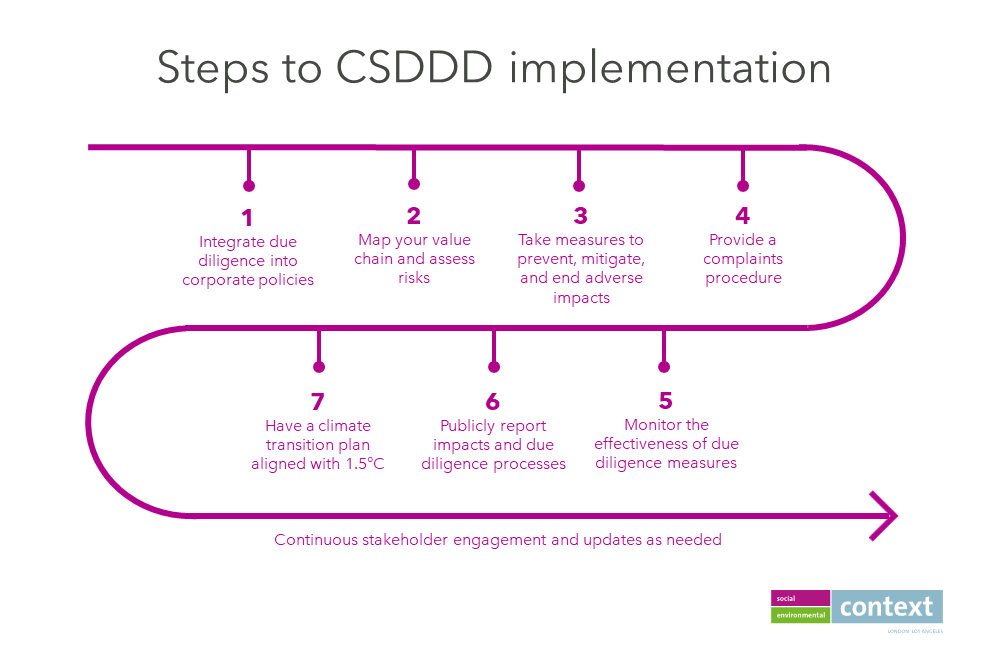
What are the key steps to implementation?
1. Integrate due diligence into corporate policies
Make sure that due diligence is integrated into all relevant policies and risk management systems. You also need to have a specific policy that ensures risk-based due diligence.
2. Map your value chain and assess risks
It’s crucial to get an understanding of where your company’s actual and potential impacts lie. Start by mapping your value chain to identify areas with adverse impacts and risks, and prioritise them based on likelihood and severity. Then companies must carry out in-depth assessments of individual suppliers in prioritised areas.
3. Take measures to prevent, mitigate, and end adverse impacts
Preventing and ending adverse impacts on human rights and the environment is the core of the CSDDD. Companies should implement the following:
Human rights and environmental strategies.
Responsiblepurchasing practices — including assurances to comply with minimum standards, and supplier screening and assessments.
Corrective measures and termination of business relationship as a last resort.
Employee and supplier training.
Stakeholder engagement.
Targeted and proportionate support for business partners who are SMEs, including fair and non-discriminatory contractual assurances.
4. Provide a complaints procedure
Companies must provide a notification system which is accessible to potentially affected stakeholders and their representatives — including NGOs and human rights defenders, for example. The complaints procedure should be fair, publicly available, accessible, and transparent. Workers and their representatives must be informed of the procedure.
5. Monitor the effectiveness of due diligence measures
Periodically assessing your due diligence measures will help you see if they’re suitable and effective. Update your due diligence policy and measures as needed.
6. Publicly report impacts and due diligence processes
Compliance with CSRD means compliance with CSDDD reporting requirements. Companies must produce a publicly available annual statement on the potential and actual adverse impacts identified and due diligence measures taken.
7. Have a climate transition plan aligned with 1.5°C
Combat climate change with a transition plan aligned with limiting global warming to 1.5°C. If you’re complying with CSRD then your climate strategy is already ticked off the list.
What’s the connection to CSRD?
They are both new EU sustainability regulations covering social and environmental factors and applying to the operations and value chains of large companies. Both require public disclosure and a climate transition plan aligned with the Paris Agreement.
But while the CSDDD focuses on preventing and ending negative effects, the CSRD focuses on transparent disclosure.
For a more in-depth analysis of the overlap between CSRD and CSDDD, watch out for our upcoming blog on how they match up.
What can you do now to get started?
The first step is to familiarise yourselves with the CSDDD requirements to understand if, when and how you must comply. Assessing existing due diligence roles, policies and management systems will help you understand your gaps and establish any roles and responsibilities needed. The next step is to map your value chain to identify and prioritise risks based on likelihood and severity.
Once you understand where your biggest risks are, devise a plan to set up the necessary due diligence measures, engaging with both internal and external stakeholders. The strategy should include: in-depth supplier risk assessments, measures to prevent and mitigate impacts, grievance mechanisms, assessments to monitor due diligence processes, annual reporting, and a climate transition plan in line with the Paris Agreement.
Context is ready to support you with all your CSDDD needs — from value chain mapping and devising due diligence strategies, to writing policies and CSRD / CSDDD-aligned reports. If you would like to talk about your organisation’s needs, please get in touch via www.contextsustainability.com or helen.fisher@contexteurope.com.
Language is a powerful — but often overlooked — tool in sustainability. It is how we shape ideas and understand the world around us. It helps us to connect with each other and with nature. By naming the things we value, we demonstrate what is important to us and to society as a whole.
Of course, language is also how we communicate knowledge about the social and environmental challenges we face ‘in a way that empowers people to take necessary actions for more sustainable lifestyles’, notes John Canning of Kingston University. And yet language figures very little in our conversations about sustainability. Neither culture nor language are explicitly mentioned within the Sustainable Development Goals (SDGs), despite the UN considering both fundamental to achieving 14 of the 17 SDGs.
There are no words for climate change in many languages, including Yoruba, Igbo and Hausa which are widely spoken in Nigeria — even though these communities are already feeling the impact of extreme weather events. Talk of ‘climate change’ can feel distant and elitist in the face of day-to-day problems.
Even within Europe, we have examples of concepts that have struggled to cross borders. In early versions of the Brundtland definition of ‘sustainable development’ first adopted by the United Nations in 1987, the term was mistranslated into French as dévéloppement durable (robust and durable) rather than dévéloppement soutenable (sustainable over the longer term).
At Context, writing is central to the work we do for our clients. We appreciate that it is sometimes hard to fully convey the sentiment expressed in one language when translating to another without losing some of the nuance and subtlety of the message.
Why does all this matter?
Given the scale of the climate and nature crises, we need to mobilise as many people to take action as possible. We have previously highlighted research indicating English-speaking consumers lack understanding of key concepts, creating a business-consumer sustainability language barrier. That challenge is multiplied for companies trying to engage with multinational teams — or work with suppliers, customers and other stakeholders across the world.
Companies may also be missing out on opportunities to identify regional best practice that could be rolled out across the business. Research into linguistic injustice by Tatsuya Amano of the University of Queensland has revealed that non-native English speakers are 2.5 times more likely to have their scientific papers rejected by a journal because they find it harder to express their ideas and convey the originality of their research in English. In the corporate world, similar linguistic challenges may translate to a shyness to speak up about local initiatives.
As Erika Darics of the University of Groningen points out, ‘specific communication strategies influence attitudes and behaviours towards sustainability issues’. The English lexicon of sustainability is dominated by terms such as ‘reduction’ and ‘efficiency’, which focus on the things we have to lose in moving to a lower-carbon world. It makes the transition feel hard and unappealing. Other languages may offer a better vision for the kind of relationship with the world we could create — something we want to move towards. As change management specialists will attest, we need to create the desire for change before we can do things differently.
The new world could be one of ‘hiraeth’ (Welsh: deep yearning for and connection with the land around us) or ‘lagom’ (Swedish: having enough or just what we need). We don’t need to be fluent in Welsh or Swedish to familiarise ourselves with these words, just as we don’t need to learn German to recognise ‘Schadenfreude’ or Danish to appreciate ‘hygge’. Getting to grips with just a few words can open our eyes to inspiration from other cultures.
Similarly, being mindful of these issues can help us to be better communicators. It is about making a conscious effort to explain strategies and concepts in clear and simple terms that won’t get lost in translation. It helps us to be more inclusive.
There are also potential benefits for brands. Research across 13 countries found that a whopping 88% of respondents wanted brands to demonstrate understanding and appreciation of national identity — and 93% wanted brands to speak to them in their own language. Sadly, only 23% of those surveyed believed that brands truly delivered. Stepping up to the mark by offering ‘engaging, culturally relevant’ messaging and customer services could be an important competitive differentiator. For Maria Schnell, Chief Language Officer at RWS, a company that develops artificial intelligence-enabled translation tools, it means layering human insight and expertise over machine translation.
There is no easy formula for how to achieve communication that is culturally relevant. The answers will vary between one organisation and the next. Developing an awareness of the issues, a deep understanding of context and focusing on stakeholder needs is a good place to start.
Many companies operate, or conduct business with partners, in challenging contexts1 that can pose significant human rights risks. This is especially true for large multinationals with complex supply chains, where the threat of modern slavery and human rights violations are a very real concern.
Adopted in 2011, the United Nations Guiding Principles on Business and Human Rights (UNGPs) establish a globally recognized framework for business and human rights. The UNGPs rest on three pillars: 1) the state’s duty to protect human rights; 2) corporate responsibility to respect human rights; and 3) ensuring access to remedy for those affected by adverse impacts.
Operational grievance mechanisms (OGMs) are formal channels to receive complaints from stakeholders affected by a company’s business activities. By fostering two-way dialogue with these stakeholders companies can resolve grievances swiftly and fairly. Establishing effective grievance mechanisms, aligned with international best practice, should be a cornerstone of any company’s strategy to uphold human rights within its operations and supply chains.
While there is no one-size-fits-all approach to building an effective grievance mechanism, all companies should consider a set of criteria when developing their OGM:
Fit for purpose: OGMs work best when tailored to the operating context. This involves specifying how and where grievances can be lodged, whether through an individual, a form, or an online platform to encourage stakeholders to use the mechanism when needed.
Clarity: Clearly defined grievance procedures outline how complaints will be handled. Transparently communicating the steps involved in investigating grievances assures stakeholders of the legitimacy of the process.
Objectivity: All complaints must be investigated objectively and thoroughly. This requires appointing trained individuals who can handle investigations impartially, without bias.
Timeliness: Promptly acknowledging and addressing complaints is essential to maintain stakeholder trust in the grievance process. This involves setting clear timelines and milestones to provide feedback on investigation outcomes and resolutions to complainants.
Confidentiality: Ensuring confidentiality and respecting the privacy of the complainant are fundamental aspects to the grievance process. Stakeholders must be assured that their identities will not be disclosed without their consent, except where necessary for investigation purposes.
Documentation: Keeping accurate records of all complaints is crucial for accountability. This also enables to companies to identify trends, hotspots of concern, and proactively mitigate recurrences.
In May 2024, the European Union formally adopted the Corporate Sustainability Due Diligence Directive (CSDDD), setting human rights standards for large companies operating within the EU. The legislation mandates companies to monitor, prevent, or remedy human rights damages throughout their operations and downstream and upstream value chains. Companies can be held liable for human rights violations they cause and will have to provide full compensation.
Context supports efforts to research, develop, and implement fit-for-purpose strategies unique to companies’ operating environment. If you’d to discuss your organization’s needs, please get in touch by e-mailing us at kyisin.aung@contextamerica.com
1 The UN Office of the High Commissioner for Human rights (OHCHR) defines challenging contexts as those with grave human rights situations due to conflict, political turmoil and/or systematic violations of human rights; those where national laws or regulations require businesses to take actions against internationally recognized rights; and those where states are not able to protect internally recognized rights.
Radical transparency has been as the antidote to greenwashing. It requires companies to be accountable and responsible for the impact of their products, services and operations and to make full and frank disclosure about how the issues are being addressed.
Radical transparency provides all stakeholders with greater information, enabling collaboration and empowering action on systemic issues that could not be tackled by any one player in isolation.
Brands can build trust in their operations, enhance their reputation and potentially gain competitive advantage by being totally — and often brutally — honest about their sustainability efforts. That means not just going public on how a company has improved its products and operations, but also being open about what they are yet to do, what they got wrong and what they have learnt along the way. It shines a light on the actions that are working — and the ones that are less effective — enabling businesses to focus their sustainability efforts in the areas that count.
While businesses should be encouraged to progressively shift towards radical transparency, it is not without its risks and timing is everything. It can open the business up for increased scrutiny — including in areas not covered by mandatory reporting requirements. Some stakeholders may misinterpret a company’s admission of shortcomings, especially in the absence of any comparisons — if competitors aren’t equally honest, any challenge the business encounters may appear to be a company-specific issue, rather than a systemic risk affecting the whole industry. It is also essential to back up statements with data demonstrating clear progress, not just awareness of the issues.
Growing reporting requirements, including the EU Corporate Sustainability Reporting Directive (CSRD) and the Corporate Sustainability Due Diligence Directive (CSDDD), mean that companies will have to report on their activities in ever greater detail. How does a business determine if it is ready to go beyond the statutory minimum and embrace radical transparency?
Sarah Walkley, Senior Sustainability Writer at Context Group explores the key questions that you should ask yourself before your company takes the plunge.
Are you doing it on your own terms?
First, it’s crucial to be clear about why you are considering boosting transparency. Is it because other companies, particularly your competitors, have gone down that road? Are their actions forcing your hand, or raising customer expectations for you to be ever more explicit about your activities?
Companies such as Ace & Tate and Noah, that are highly transparent about their activities, have done their preparation and evolved their approach over time. They have been collecting data on all aspects of their business, developed and tested the messaging and ensured they can tell a coherent story.
They have embraced a more transparent approach on their own terms — not been cajoled into it by those around them.
Are you prepared for employees to ask anything?
Does your company provide every opportunity for employees to ask questions about corporate and sustainability strategy as part of regular townhalls and updates? And are they provided with full and frank answers?
The most transparent companies have ‘Ask me anything’ sessions in place. They provided a testbed for what companies are ready to talk about publicly. If a company is not yet ready to put its cards on the table and talk about its sustainability progress internally — both the positives and the negatives — then it is not ready to share that information externally.
How do you think other stakeholders will react?
If your company is already fully open about its activities internally, the next step is to think about how other stakeholders would react to you telling all — and potentially doing so in a way that may be quite different from how you communicate now.
Ace & Tate made no secret of the fact it had made some bad decisions on its journey to becoming a B Corp and had ‘f*cked up’ at times. It made a break from the typically staid tones of corporate communications to indicate that it was not just saying something different — it was also doing things differently, for example reversing a decision to use polyurethane in its glasses cases, which helped to reduce emissions but increased water consumption.
For other organisations, including Noah, Ganni and Patagonia, it starts by acknowledging that they are not sustainable companies. Their focus is on being the most responsible businesses they can be.
If suggestions that your company follows a similar approach are greeted with consternation and worry about what shareholders, suppliers or customers would say, then maybe now is not the time for radical transparency. However, just having the conversation should help to flush out the biggest areas of concern which need to be addressed to unlock a willingness to be more open.
Could you go above and beyond?
The European Sustainability Reporting Standards (ESRS) list the data points that companies subject to CSRD will have to report on. There are over 1,000 data points in total — most companies will be required to publish data on a few hundred points covering the material sustainability matters that are most relevant to their business.
Companies can choose to be even more transparent and report against additional data points.
But the mandatory reporting requirements under ESRS and CSRD are already a big ask, especially for many private companies that fall within the scope of mandatory reporting for the first time.
Does your company have capacity to go above and beyond the base requirements at this stage?
Are you prepared to reveal the full picture?
Are you ready to share the truth, the whole truth and nothing but the truth?
Specificity is the key to avoiding greenwashing. The Directive on Empowering Consumers for the Green Transition (also known as ‘the Greenwashing Directive’) has made that abundantly clear in restricting the use of generic terms such as ‘green’ and ‘eco friendly’ and regulating the format of acceptable claims, e.g. ‘this bottle is made of 30% recycled plastic’.
But focusing so specifically on one aspect of a product raises questions about other, less favourable attributes, or even other products. Why is the product not made entirely of recycled plastic or even a different material, for example? Or why are other products still sold in non-recyclable sachets rather than recycled and recyclable bottles?
It is as important to reveal what you are not doing and why as it is to communicate where you are making progress. Like Noah, Ganni and Patagonia, that may mean setting the record straight that there is no such thing as a truly sustainable company — only ones that are trying to make a difference where they can and minimise any inevitable impact.
Are you willing to share what went wrong?
No initiative ever goes entirely to plan. Things take longer than you think. Projects cost more. And unexpected challenges always emerge along the way. But these setbacks all bring valuable learning, enhancing future initiatives. They enable companies to identify where greater collaboration would help to tackle systemic issues.
Radical transparency requires humility and openness about what went wrong, what you have learnt from the experience and how that is shaping future activities. Bragging only about what went right will sound hollow.
Are your stakeholders already using AI to judge your efforts?
Are your stakeholders using artificial intelligence to assess your actions? Tools such as ChatIPCC, ClarityAI, GreenwatchAI and ClimateBert enable users to compile information from a disparate range of sources and draw their own conclusions about whether your organisation is living up to its sustainability ambitions.
The most robust response is to be more open about your approach and consistent in the way that you talk about activities. The technology can flush out a poorly considered press release issued in a minor market or an unguarded comment uttered in an interview, making it easier than ever before for stakeholders to question your strategy. Consistent messaging is essential to prevent this and is the foundation to radical transparency.
Context supports companies to hit the right tone with their sustainability strategy, reporting and communications — encouraging transparency and building credibility and enabling delivery of impact-led sustainability strategies. If you would like to talk about your organisation’s needs, please get in touch via www.contextsustainability.com or helen.fisher@contexteurope.com.